What Should My Business Do About The DPDPA?

What should my business do about the DPDPA?

The Digital Personal Data Protection Act, 2023 and the DPDP Rules, 2025 are now in force in phases, and the compliance clock is running. This page is a working resource for business leaders. Start with the decision you are actually trying to make, not with three hundred pages of statute.
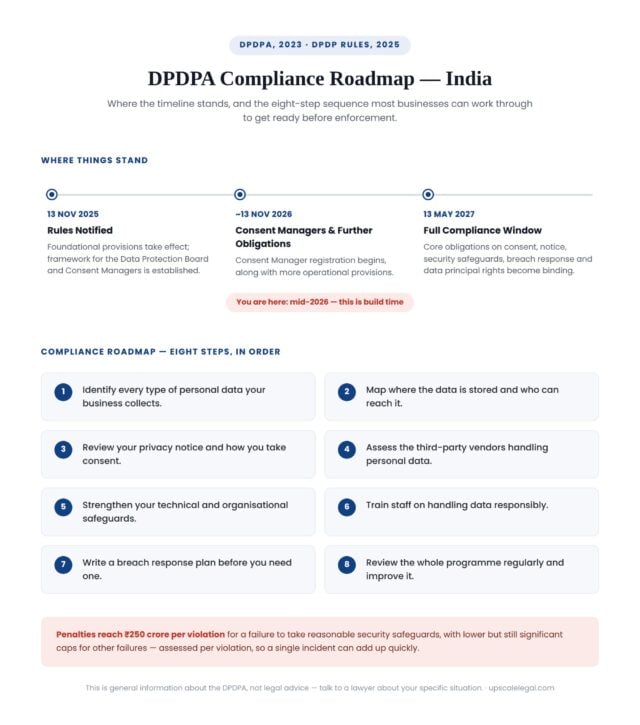
Where Things Stand

The DPDP Rules, 2025 have been notified, and core obligations under the DPDPA framework will become fully binding in May 2027, following a phased commencement over roughly eighteen months. That runway is short for the amount of work most businesses have to do.

Most of the real work mapping your data, fixing notices and consent, sorting vendor contracts, tightening security, setting up breach response takes several quarters. Businesses that start now arrive at enforcement with defensible systems. The ones that wait until 2027 end up rebuilding under live scrutiny.

13 Nov 2025 · RULES NOTIFIED
Foundational provisions under the DPDP Rules take effect and the framework for the Data Protection Board and Consent Managers is established.

Around 13 Nov 2026 · CONSENT MANAGERS & FURTHER OBLIGATIONS
Consent Manager registration and related obligations begin, and more operational provisions come into force.

13 May 2027 · FULL COMPLIANCE WINDOW
The main obligations on consent, notice, security safeguards, breach response, and data-principal rights become binding for covered Data Fiduciaries.tcsa+1

You are here: mid-2026. This is build time.


Decision Finder

Start with your business question.

Pick the decision you are trying to make. Each answer is a plain starting point from our team. Where your situation needs proper advice, it says so.


Marketing

1. Can I use customer WhatsApp numbers for promotions?
Sometimes. It depends on why you collected the numbers and what people agreed to at the time. A number someone gave you to confirm a delivery was not necessarily given to you for marketing, and using it that way may not match the original basis. Check what your records actually say before you run anything.

Next step: Check your consent records before you send a campaign.


2. Can I send marketing emails under the DPDPA?
Often you can, provided you have a defensible basis for each list and a working way for people to opt out. The trouble tends to start with vague consent and unsubscribe links that do not do anything in practice.

Next step: Confirm your basis for each list and test that unsubscribe works.


3. Can I buy customer databases?
In most cases, buying customer databases is high-risk and difficult to defend from a consent standpoint. Bought lists almost never carry consent that clearly transfers to you, and if the data was collected improperly, the exposure becomes yours when you start using it.

Next step: Build your own opted-in list instead of buying one.


4. Can I use website cookies and analytics?
It depends on what the cookies collect and what you tell visitors. Basic traffic analytics sits at the lower end of the risk. Tracking that ties back to identifiable people, or that builds profiles across services, sits higher and needs clearer notice and basis.

Next step: Read your own cookie notice against what your tools actually collect.


5. Can I collect leads from LinkedIn?
Public does not mean fair game. A profile being visible is not the same as that person agreeing to sit in your outreach list. Scraping and cold messaging carry more risk than most people assume, especially when they involve large volumes of personal data.

Next step: Confirm your lawful basis for processing before you build the list.


Human Resources

1. Can employees ask us to delete their records?
Some of it, yes. Some of it, no. Payroll and statutory records often have to be kept for a set period under other laws. Other data may be deletable on request if you no longer have a good reason to keep it. The answer depends on the record, not only on who is asking.

Next step: Sort your employee records into what you must keep and what you can remove.


2. Can we monitor company email?
Often you can, if you have a clear policy, you have told staff in advance, and the monitoring is proportionate to a real purpose such as security or compliance. Quiet or blanket monitoring is where firms tend to get into trouble.

Next step: Put a written monitoring policy and a staff notice in place first.


3. Can we hold on to resumes?
Keeping every CV forever is hard to defend. Recruitment records should run to a stated retention period you can point to, and you should clear out what you no longer need.

Next step: Set a retention period for recruitment records and hold to it.


4. Can we use biometric attendance?
Biometric data is more sensitive than a swipe card, and it should be treated that way. You need a genuine reason for using it, stronger security around it, and usually an alternative for staff who object or cannot use the system.

Next step: Test whether you truly need biometrics, and what protects them, before rolling it out.


AI & Technology

1. Can I upload contracts to AI tools like ChatGPT?
You should be cautious. Contracts carrying personal or commercially sensitive detail should not go into consumer AI tools without safeguards, because you often cannot control where that data sits, how it is used, or who can access derivative outputs.

Next step: Agree an internal AI usage policy before anyone uploads client material.


2. Can employees use AI tools at work?
Yes, within some rules. The tool is rarely the problem on its own. The real risk is staff pasting client data or confidential documents into it without thinking through where that information goes.

Next step: Publish an AI usage policy and a list of approved tools.


3. Can AI process customer information?
It can, where you have a lawful basis and appropriate protections around it. The details that matter are the vendor’s terms, where the data sits, how it is secured, and who can see it, including any human review of outputs.

Next step: Read the tool’s terms and confirm your basis before feeding it customer data.


4. Can Copilot-style assistants access confidential documents?
An assistant can see whatever it has permission to see. If your file permissions are loose, sensitive material can surface in places it should not. Turning on document-aware AI without cleaning up access can expose more than you realise.

Next step: Tighten document access before switching on document-aware AI.


Vendors & Contracts

1. Do I need Data Processing Agreements? · FOUNDATIONAL
In most cases, yes, wherever a vendor handles personal data for you. A data processing agreement is one of the first things to get in place, because a good deal of your other protection depends on it.

Next step: Put data processing agreements in place with the vendors that need them.


2. What happens if my vendor suffers a data breach?
Their failure can still be your problem. As the business that chose to use them, you may remain accountable for the personal data in question. Your contract terms and your due diligence are what stand between you and that exposure.

Next step: Keep vendor due diligence current and have a breach response plan ready.


3. Can vendors transfer customer data overseas?
Moving data out of the country is not automatically unlawful, but it needs looking at first, not after. The contract terms, the regulatory position on cross-border transfers, and the security around the transfer all matter.

Next step: Review the transfer terms and applicable rules before any data leaves India.


4. Who is responsible for a vendor’s mistakes?
Often, you are. That is exactly why the contract and the processing agreement carry so much weight. Outsourcing the work does not outsource the responsibility with it; you may still remain the Data Fiduciary for the data.

Next step: Set out liability and obligations clearly in every vendor contract.


By Sector

Same law, different data, different fixes.

What you hold, and the risk attached to it, depends on what you do. Sector guides are being added. Start where your business sits.

  • Healthcare & Diagnostics
    Patient records, reports over WhatsApp, telemedicine, insurance coordination.
  • SaaS & Technology
    User accounts, analytics, APIs, AI platforms, cross-border data.
  • Education
    Admissions, student and parent data, LMS platforms, alumni engagement.
  • E-Commerce & D2C
    Customer accounts, payments, marketing pixels, loyalty programmes.
  • HR & Corporate
    Recruitment, payroll, employee records, attendance systems.
  • Fintech & NBFC
    KYC, PAN and Aadhaar, credit profiling, partner and agent access.


Compliance Roadmap

Eight steps, in order.

A practical sequence most businesses can work through from the top.

  1. Identify every type of personal data your business collects.
  2. Map where the data is stored and who can reach it.
  3. Review your privacy notice and how you take consent.
  4. Assess the third-party vendors handling personal data.
  5. Strengthen your technical and organisational safeguards.
  6. Train staff on handling data responsibly.
  7. Write a breach response plan before you need one.
  8. Review the whole programme regularly and improve it.


Why Upscale Legal

Practical guidance for business decisions.

A lot of legal advice tells you what the law says and stops there. That part is important, but the harder and more useful question is what your particular business should do about it, and that is the part we work on with you. Our team focuses on turning statutory obligations into concrete steps, with commercial sense attached, so you leave with something you can put into practice.


Common Questions

1. Does the DPDPA apply to startups and small businesses?
If your business handles digital personal data, the Act can apply whatever your size. What you actually have to do depends on your activities and on any government notifications that apply to you, including exemptions or special treatment for certain categories of Data Fiduciaries.

2. When is the DPDP compliance deadline?
The DPDP Rules were notified in November 2025 and commence in phases. Current guidance reflects an eighteen-month runway to full obligations, with core substantive duties on consent, notice, security safeguards, breach response, and data-principal rights becoming fully binding around 13 May 2027.

3. Do we need a Data Protection Officer?
That depends on your business, the kind of processing you do, and whether the additional obligations for larger or Significant Data Fiduciaries apply to you. If you hold large volumes of sensitive data or perform high-risk processing, this is something that needs a specific assessment rather than a generic answer.

4. What are the penalties under the DPDPA?
Penalties are imposed by the Data Protection Board under the DPDP framework and can reach ₹250 crore per violation for a failure to take reasonable security safeguards, with lower but still significant caps for other kinds of failures. They are assessed per violation, so a single incident can add up


Speak With Us

No two businesses hold data the same way.

Whether you are putting a privacy programme together, checking your contracts, or bringing in AI tools, a conversation can help you prioritise work and take a fair amount of avoidable risk off the table before it becomes a problem.

This is an enquiry, not a request for advice on specific facts. Getting in touch does not create a lawyer–client relationship.

Disclaimer: Everything here is general information about the DPDPA, not legal advice. What you have to do depends on your own facts. For guidance on your situation, talk to a lawyer.

Need Legal Guidance?

Schedule a Consultation

UPSCALE LEGALAbout
Upscale Legal is a multi-service law firm catering to the needs and interests of various Corporate houses, Financial institutions, Government agencies & departments, along with assisting in supplementary business & legal issues of our individual clients.
AWARDSOur Presence
https://upscalelegal.com/wp-content/uploads/2022/09/iblj.jpg
The 10 Highly Recommend
Untitled design (1)
Legal era
Insight
image 6
image 5
Untitled design (2)
Legal Era awards
certificate-of-Indian-business-law-journal-new
GET IN TOUCHUpscale Social links
UPSCALE LEGALHeadquarters
Upscale Legal is a multi-service law firm catering to the needs and interests of various Corporate houses, Financial institutions, Government agencies & departments, along with assisting in supplementary business & legal issues of our individual clients.
OUR LOCATIONSWhere to find us
https://upscalelegal.com/wp-content/uploads/2019/04/img-footer-map.png
AWARDSOur Presence
https://upscalelegal.com/wp-content/uploads/2022/08/Awards.png
GET IN TOUCHSocial links

Copyright by Upscale Legal. All rights reserved.

Copyright by Upscale Legal. All rights reserved.

Devraj Singh

Devraj Singh is a law graduate from Christ (Deemed to be University), Pune, with a specialization in business and corporate law. His professional experience spans Corporate Advisory, Regulatory Compliance, Technology Law, Data Privacy, Cyber Law, and Commercial Dispute Resolution, enabling him to provide comprehensive legal solutions that balance business objectives with regulatory requirements.

Through his experience with law firms and compliance organizations, Devraj has gained substantial experience in drafting, reviewing, and negotiating commercial, technology, and employment-related agreements, including Software Development Agreements, MSAs, NDAs, Employment Agreements, Terms of Service, and other commercial contracts. He has advised on contract management, regulatory compliance, legal due diligence, corporate governance, tender compliance, and risk assessment, while assisting businesses in navigating complex legal and operational challenges across technology, financial, and regulated sectors. He regularly advises clients on tender compliance, procurement processes, corporate governance, regulatory approvals, legal due diligence, vendor management, and risk mitigation strategies.

His practice extends to day-to-day corporate compliance management, regulatory audits, compliance monitoring frameworks, policy drafting, internal governance mechanisms, enterprise risk assessment, and business process compliance. He has assisted companies in evaluating legal and regulatory obligations across sectors including technology, telecommunications, healthcare, financial services, infrastructure, and emerging digital businesses. His work also includes advising on labour and employment compliance, corporate structuring, regulatory registrations, and operational legal risk management.

In the field of Technology, Data Privacy, and Artificial Intelligence Law, Devraj has advised on the Digital Personal Data Protection Act, 2023, GDPR compliance, Data Protection Impact Assessments (DPIAs), consent management frameworks, CERT-In reporting obligations, cybersecurity governance, platform regulations, intermediary liability, and emerging AI regulatory frameworks. He has prepared legal opinions and compliance memoranda on the EU AI Act, Digital Services Act, online gaming regulations, data protection requirements, and technology-driven business models. His academic and professional interests further extend to AI governance, cybersecurity regulation, digital platforms, and the legal implications of emerging technologies.

Devraj has also been actively involved in complex legal due diligence exercises, including high-value investment transactions, reviewing commercial contracts, intellectual property arrangements, confidentiality frameworks, and regulatory exposures. His experience includes advising on anti-bribery and anti-corruption laws, cross-border compliance obligations, sanctions regimes, accessibility regulations, and corporate compliance standards across multiple jurisdictions.

On the disputes side, Devraj has assisted in commercial litigation, debt recovery proceedings, cyber fraud investigations, contractual disputes, and regulatory proceedings. His experience includes drafting pleadings, legal notices, complaints, recovery strategies, arbitration-related research, and litigation support before courts, tribunals, and regulatory authorities. He has also worked on matters involving insolvency law, infrastructure disputes, property-related claims, cybercrime investigations, and complex commercial recoveries.

Devraj’s practice is driven by a strong focus on regulatory compliance, risk management, corporate governance, technology law, and strategic legal advisory. He regularly assists businesses in identifying legal risks, strengthening compliance frameworks, managing contractual relationships, ensuring regulatory adherence, and supporting management in making legally sound and commercially viable decisions.

Kshitij Suri

Kshitij Suri is a practicing advocate, having completed his B.A.LLB from the University School of Law and Legal Studies, with focused experience in civil and criminal litigation. He has trained and practiced in a rigorous chamber environment prior to joining the Firm, where his work was primarily rooted in trial-level advocacy across a range of forums.

His practice includes handling civil disputes, consumer litigation, and select criminal matters, with substantial involvement in drafting pleadings, applications, written arguments and legal notices.

He is also adept in conducting in-depth and exhaustive legal research, providing comprehensive legal answers.

Aditya Chopra

Aditya is a professionally qualified Advocate with over 8 years of post-qualification experience, specializing in diverse domains including Commercial Law, Dispute Resolution, Contract Management, Corporate Advisory, Tender Management, Labor & Employment, Intellectual Property Rights, Document Processing, Business Set-up & Management Services, and Start-Up Advisory.

His expertise lies in contract management, due diligence, corporate advisory, and litigation, where he has successfully drafted, negotiated, and reviewed complex agreements, conducted risk assessments, ensured regulatory compliance, and represented clients before various judicial and quasi-judicial forums. Aditya has actively handled high-stakes disputes and achieved tangible results through negotiations, settlements, and arbitration.

With a strong foundation in legal drafting and research, Aditya is adept at providing strategic solutions to clients across industries. I take pride in building and maintaining trusted professional relationships with clients, colleagues, and law enforcement authorities, thereby ensuring effective outcomes and long-term success.

Vagisha Gupta

Vagisha is a highly skilled legal professional with extensive experience as an advocate, legal advisor, and consultant, specializing in litigation, arbitration, and corporate advisory. I have successfully represented clients before labour courts, sessions courts, trial courts, and the High Court of Delhi, handling diverse legal disputes with strategic precision and professionalism. Her expertise spans drafting and reviewing a wide range of legal documents, including commercial suits etc.

In the corporate sphere, Vagisha has conducted comprehensive due diligence in transactions, evaluated risks, and ensured adherence to regulatory frameworks across HR policies and governance structures. Ms. Gupta has advised clients extensively on employment agreements, labour law compliance, and POSH policies, contributing to legally sound and ethically compliant workplaces. Vagisha’s work reflects a blend of technical legal expertise and practical business insight, ensuring effective solutions for complex challenges.

With strong analytical, drafting, and negotiation skills, she remains committed to safeguarding client interests, upholding the highest standards of ethics and confidentiality, and fostering enduring professional relationships.

Shreya Shrivastav

Shreya Shrivastav is a strategic outreach and coordination professional with over three years of cross-functional experience spanning HR operations, stakeholder management, and growth-oriented communication. At Upscale Legal, she operates at the intersection of leadership coordination and external engagement, working closely with founders, HR heads, and institutional partners.

Her expertise lies in people management, structured planning, negotiation, and disciplined execution. She plays a key role in managing professional relationships, coordinating internal teams, and ensuring seamless communication across operational and growth initiatives. Her ability to balance strategy with execution allows her to contribute meaningfully to both organizational development and market positioning.

Shreya brings a strong foundation in digital marketing and operational structuring, enabling her to align outreach efforts with long-term business objectives. She is known for her clarity in communication, composure in professional interactions, and ability to build trust-driven relationships.

Her approach is deliberate and growth-focused — combining strategic thinking with reliable execution.

Saurabh Dikshit

Saurabh is a corporate law professional holding a B.A., LL.B. (H) (Batch 2016–2021) and a Master’s degree in Corporate Law from Amity University (Batch 2023–24), with over two years of focused experience in corporate advisory and real estate transactions. He currently serves as a Legal Associate at Upscale Legal, advising clients on a wide spectrum of commercial, transactional, and regulatory matters.

His core expertise lies in transaction structuring, drafting, and documentation, including Lease Deeds, Sale Deeds, MOUs, MSAs, Trust Deeds, Undertakings, NDAs, Settlement Deeds, and Statutory Legal Notices, including Notices under Section 138 of the Negotiable Instruments Act, 1881. He has substantial experience in conducting legal Due Diligence, Share Transfer Transactions, Labour Law Advisory, Licensing and Regulatory Registrations, and Comprehensive Document Vetting across complex commercial arrangements.

He has actively handled corporate leasing transactions and conducted extensive real estate and corporate due diligence for a leading edutech enterprise undertaking pan-India expansion, supporting multi-city commercial leasing, title verification, regulatory compliance, and transaction risk assessment across jurisdictions.

His practice reflects strong proficiency in contract management, risk assessment, corporate governance advisory, and dispute pre-litigation strategy. He brings a commercially driven approach to legal structuring, ensuring enforceability, compliance, and long-term risk mitigation for his clients.

Samriddhi Goswami

Samriddhi Goswami is a law graduate from the Faculty of Law, University of Delhi (Batch 2021–2024). Her professional journey has provided her with substantial exposure to both Corporate Advisory and Litigation, enabling her to address legal issues from preventive as well as remedial perspectives.

With approximately one year of post-qualification experience in Corporate Advisory, she has developed proficiency in drafting and reviewing a wide range of complex agreements, including Service Agreements, Memorandum of Understanding (MoUs), Lease Deeds, and Non-Disclosure Agreements (NDAs). Her practice further extends to Intellectual Property advisory, Labour and Employment law matters, Real Estate transactions, Tender management, Due Diligence, Mergers and Acquisitions (M&A) support, RERA compliance, and regulatory registrations, including TRAI compliance and Start-up advisory.

On the litigation front, she has represented clients before various judicial forums, including District Courts, the High Court of Delhi, and several Tribunals. Her litigation experience encompasses civil disputes, criminal matters, labour and employment disputes, and proceedings under Section 138 of the Negotiable Instruments Act.

Anushrut Rajawat

A versatile legal professional with a strong foundation in both corporate law and litigation. Anushrut holds a B.A.LL. B from the School of Law, University of Petroleum and Energy Studies, Dehradun. His journey in the legal field began early, as he gained invaluable experience as a legal advisor during my 5th year of law school.

With over one year of post-qualification experience at Upscale Legal, He has developed a robust skill set. Anushrut’s corporate experience includes drafting and reviewing a wide range of agreements (including SHA’s, NDAs, and Service Agreements), conducting due diligence for real estate and company acquisitions, and managing regulatory tasks such as GST registrations. He has also gained unique insight into corporate legal departments through a client secondment.

On the litigation front also, he has a proven track record of representing clients in civil and criminal matters before the District Courts and High Court of Delhi. Anushrut has specific expertise in recovery and labour matters, providing effective legal counsel and representation in court. This dual expertise allows him to offer comprehensive legal solutions, blending proactive corporate advice with assertive dispute resolution.

Jasleen Kaur

Jasleen Kaur is an Advocate providing comprehensive legal solutions across a broad spectrum of practice areas. She has developed a dynamic and well-rounded practice that seamlessly combines effective courtroom advocacy with strategic legal advisory services for individuals, corporates, and institutions. She holds a Bachelor of Laws (LL.B.) degree and commenced her professional journey in 2017 through extensive internships and rigorous practical training. This early exposure afforded her substantial hands-on experience in both litigation and corporate law even prior to her formal enrolment as an Advocate, enabling her to cultivate a mature, practical, and in-depth understanding of the legal profession from an early stage.

Jasleen is recognised for her strong command over litigation and dispute resolution, having successfully represented clients before District Courts, High Courts, arbitral tribunals, and statutory forums. Her practice spans civil litigation, criminal defence, arbitration proceedings, labour and employment disputes, matrimonial and family law matters, consumer complaints, corporate and commercial disputes, and cases under Section 138 of the Negotiable Instruments Act (cheque dishonour matters). She has developed a particularly robust practice in criminal law, handling complex trials, sensitive matters, and bail applications with precision and diligence. She is also actively involved in critical stages of criminal proceedings, including police station proceedings, interactions with investigating officers, and safeguarding clients’ procedural and constitutional rights at every stage.

In the field of arbitration, Jasleen possesses a strong working knowledge of the Arbitration and Conciliation Act, 1996, and regularly appears in arbitral proceedings, including matters before institutional arbitration forums. She is experienced in drafting pleadings, applications, and written submissions, managing procedural aspects of arbitration, and advising clients on strategy and enforcement.

She also commands significant expertise in labour and employment laws, representing clients in disputes relating to illegal termination, non-payment of dues, disciplinary proceedings, industrial disputes, and service-related matters before Labour Courts, Industrial Tribunals, and other appropriate forums. Her approach in labour matters is both legally sound and commercially pragmatic, balancing employer compliance with employee rights.

In addition to domestic corporate advisory, Jasleen advises clients on international incorporation and cross-border business structuring, assisting startups and businesses with company incorporation in foreign jurisdictions, regulatory compliance, shareholder structuring, and coordination with overseas professionals, ensuring legally sound and commercially viable expansion beyond India.

Jasleen has actively participated in court-referred mediations, facilitating amicable and commercially viable settlements in civil and matrimonial disputes. She has further handled accident claims, sensitive criminal cases, and disputes arising out of altercations, equipping her with a comprehensive and practical understanding of civil, criminal, and quasi-criminal proceedings.

While litigation remains her core strength, she also efficiently manages complex corporate and commercial assignments, including drafting, vetting, and negotiating high-value contracts, agreements, and legal documentation. Her drafting and advocacy are marked by clarity, precision, and persuasive articulation, and she is particularly known for identifying weaknesses in the opposing party’s case and presenting focused, effective submissions before judicial and arbitral forums.

Disclaimer

Welcome to the website of Upscale Legal. As per the rules of the Bar Council of India, lawyers and law firms are not permitted to solicit work or advertise. By clicking on the “AGREE” button below, the website visitor agrees and acknowledges that:-

* There has been no advertisement, personal communication, solicitation, invitation or any other inducement of any sort whatsoever by or on behalf of Upscale Legal or any of its members to solicit any work through this website.
* The user wishes to gain more information about Upscale Legal for his/her/their own information and use.
* All information about Upscale Legal on this website is being provided to the user only on his/her/their specific request and any information obtained or materials downloaded from this website is completely at the user’s volition and any transmission, receipt or use of this site would not create any lawyer-client relationship.
* All material and information (except any statutory instruments or judicial precedents) on this website is the property of Upscale Legal, and no part thereof shall be used, with or without adaptation, without the express prior written consent of Upscale Legal