
How do you incorporate a private limited company in India?
Author by: Rashi Anand Suri
Incorporating a private limited company in India is a 12-step process under the Companies Act, 2013, running across three phases: pre-incorporation prep (structure, digital signatures, director IDs, name reservation), incorporation filing (MOA/AOA, SPICe+, ROC approval, Certificate of Incorporation), and post-incorporation compliance (bank account, first board meeting, auditor appointment, and the INC-20A commencement declaration). Most of it is now handled through the integrated SPICe+ form on the MCA portal.
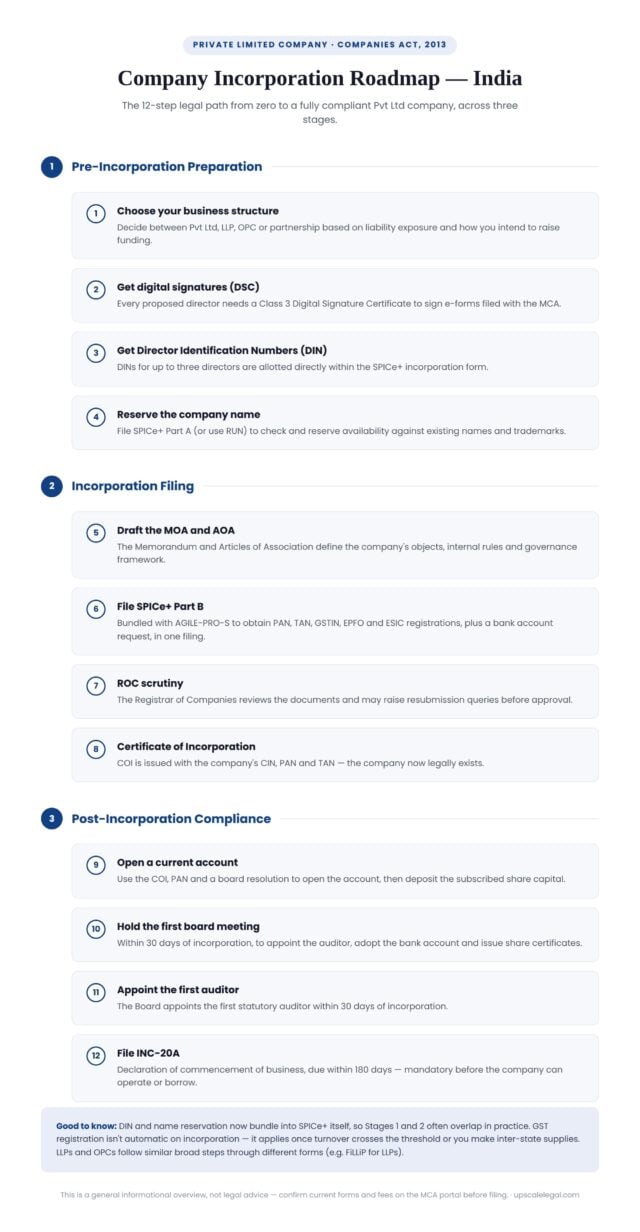
Stage 1 – Pre-incorporation preparation
Choose your business structure. Decide between a private limited company, LLP, OPC, or partnership, based on your liability exposure and how you intend to raise funding. A Pvt Ltd is usually the right vehicle for anyone planning to take external investment.
Get digital signatures (DSC). Every proposed director needs a Class 3 Digital Signature Certificate to sign the electronic forms filed with the Ministry of Corporate Affairs.
Get Director Identification Numbers (DIN). DINs for up to three directors can be allotted directly within the SPICe+ incorporation form, so a separate application usually isn’t needed.
Reserve the company name. File SPICe+ Part A (or use the RUN service) to check and reserve availability. Check the name against both existing companies and registered trademarks — a name that clears the MCA can still infringe a trademark.
Stage 2 – Incorporation filing
Draft the MOA and AOA. The Memorandum and Articles of Association define the company’s objects, internal rules, and governance framework.
File SPICe+ Part B. This is the main incorporation form, bundled with AGILE-PRO-S to obtain PAN, TAN, GSTIN, EPFO and ESIC registrations and a bank account request in a single filing.
ROC scrutiny. The Registrar of Companies reviews the documents and may raise resubmission queries before approval.
Certificate of Incorporation. Once approved, the COI is issued with the company’s CIN, PAN and TAN. At this point the company legally exists.
Stage 3 – Post-incorporation compliance
Open a current account. Use the COI, PAN and a board resolution to open the account, then deposit the subscribed share capital.
Hold the first board meeting. This must be held within 30 days of incorporation, to appoint the auditor, adopt the bank account, and issue share certificates.
Appoint the first auditor. The Board appoints the first statutory auditor within 30 days of incorporation. (Filing Form ADT-1 for the first auditor is recommended as good practice, though its strict necessity for the first auditor is a debated point — confirm the position with your advisor.)
File INC-20A. The declaration of commencement of business is due within 180 days of incorporation and is mandatory before the company can begin operations or borrow.
Good to know
DIN and name reservation now bundle into SPICe+ itself, so in practice Stages 1 and 2 overlap. GST registration isn’t automatic on incorporation it becomes mandatory only once turnover crosses the applicable threshold or you make inter-state supplies. LLPs and OPCs follow similar broad steps through different forms (for example, FiLLiP for LLPs). And incorporation is the start, not the end: annual ROC returns, statutory audit and income tax filings continue every year.
FAQ
How long does it take to incorporate a company in India?
With documents in order, incorporation through SPICe+ typically completes within a few working days, subject to ROC scrutiny and any resubmission queries.
What is INC-20A and why does it matter?
INC-20A is the declaration of commencement of business, due within 180 days of incorporation. It is mandatory before the company starts operations or borrows, and missing it carries penalties.
Do I need GST registration when I incorporate?
Not automatically. GST is required once turnover crosses the applicable threshold or you make inter-state supplies, among other triggers.
Disclaimer: This is a general informational overview, not legal advice confirm current forms and fees on the MCA portal before filing.


