
How do you register as a recognised startup in India?
Author by: Rashi Anand Suri
Registering as a recognised startup in India means obtaining DPIIT recognition on top of an already-incorporated entity, then applying separately for its benefits. There are three phases: confirm eligibility (incorporated as a Pvt Ltd, LLP or registered partnership; under 10 years old; turnover under ₹100 crore; genuinely innovative and not a reconstruction), obtain DPIIT recognition via the Startup India portal, and then unlock benefits — the 80-IAC tax holiday, self-certification, and IPR and procurement fast-tracks. Note that angel tax was abolished by the Finance Act 2024, so raising capital at a premium no longer triggers a Section 56(2)(viib) liability.
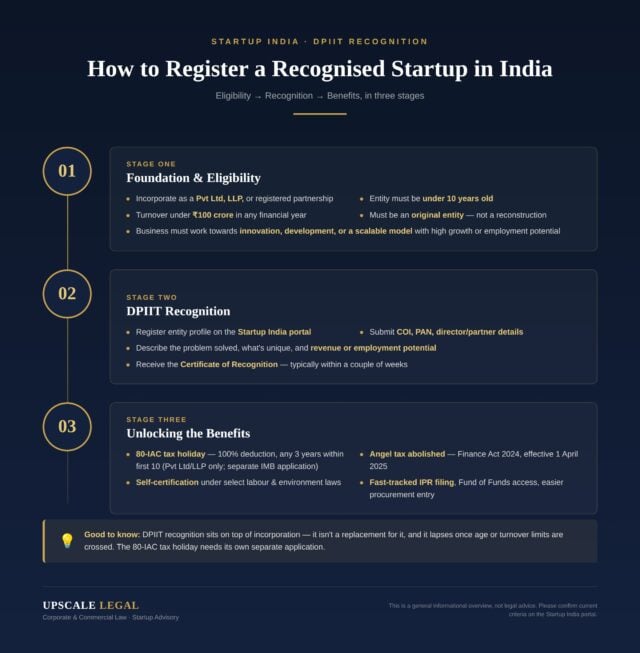
Stage 1 – Foundation and eligibility
Incorporate the entity first. Register as a private limited company, LLP, or registered partnership firm. (Note: only a Pvt Ltd or LLP will later qualify for the 80-IAC tax holiday a partnership firm can get DPIIT recognition but is not eligible for that specific tax benefit.)
Check the age and turnover limits. The entity must be under 10 years old, with annual turnover not exceeding ₹100 crore in any financial year since incorporation.
Confirm it’s an original entity. It must not have been formed by splitting up or reconstructing an existing business.
Frame the innovation angle. The business must work towards innovation, development, or improvement of products, services or processes or be a scalable model with high potential for employment or wealth creation.
Stage 2 – DPIIT recognition
Register on the Startup India portal. Create an account at startupindia.gov.in and set up the entity profile.
Apply for DPIIT recognition. Submit the Certificate of Incorporation, PAN, director/partner details, and a brief on the business.
Describe innovation and scalability. Explain the problem being solved, what makes it unique, and its revenue or employment-generation potential.
Receive the Certificate of Recognition. DPIIT reviews the application and grants recognition, usually within a couple of weeks.
Stage 3 – Unlocking the benefits
Apply for the 80-IAC tax holiday. Recognised startups can claim a 100% income-tax deduction on profits for any three consecutive years within their first ten years of incorporation. This is a separate application to the Inter-Ministerial Board (IMB) DPIIT recognition alone doesn’t grant it and it’s available only to private limited companies and LLPs. The incorporation-eligibility window for 80-IAC currently runs to 31 March 2030.
Angel tax now abolished. This is a change many founders have missed: angel tax under Section 56(2)(viib) was abolished by the Finance Act 2024, effective 1 April 2025, for all categories of investors. Startups can now raise capital at any premium without the old share-premium tax liability. One caveat fund raises from before that date can still attract assessment for those prior years, so legacy exposure hasn’t disappeared entirely.
Self-certify compliance. Recognised startups can self-certify under select labour and environment laws, reducing the inspection burden.
Access schemes and fast-tracks. Recognition unlocks fast-tracked patent and trademark filing with fee rebates, access to the Fund of Funds for Startups, and easier participation in public procurement.
Good to know
DPIIT recognition is a status added on top of an incorporated entity, not a replacement for it. The 80-IAC tax holiday is a distinct step with its own IMB review and, as noted, partnership firms are excluded from it. Recognition lapses once the age or turnover limits are crossed. And many states run their own parallel startup policies with additional grants, so it’s worth checking your state portal alongside the central scheme.
FAQ
Is angel tax still applicable in India?
No. Angel tax under Section 56(2)(viib) was abolished by the Finance Act 2024, effective 1 April 2025, for all categories of investors. New fund raises are not subject to it, though pre-April-2025 raises can still face assessment for those years.
Does DPIIT recognition automatically give a tax holiday?
No. The 80-IAC tax holiday requires a separate application to the Inter-Ministerial Board and is available only to private limited companies and LLPs, not partnership firms.
What are the eligibility limits for startup recognition?
The entity must be under 10 years old, have turnover under ₹100 crore in any financial year, be incorporated as a Pvt Ltd/LLP/registered partnership, work towards innovation, and not be formed by reconstruction of an existing business.
Disclaimer: This is a general informational overview, not legal advice confirm current criteria on the Startup India portal.


